Why We Still Look at Art: The Act of Seeing in an Age of Distraction
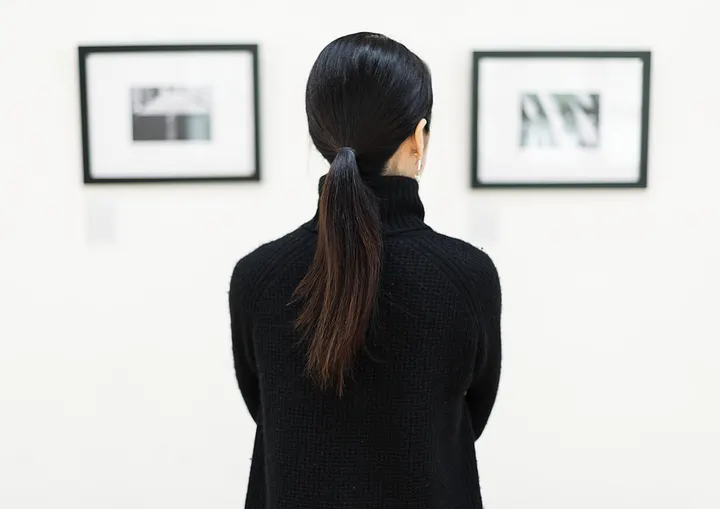
Whether it’s due to the number of children I now have — each of them navigating the often-cited phenomenon of clip-thinking — or simply the pace of the world we inhabit, the notion of standing silently in front of an artwork, of simply looking, has come to mean a great deal to me. In a world of notifications, fractured attention spans, and infinitely scrolling feeds (not to mention the stock exchange tickers running in the background), this act can feel like a quiet form of resistance.
And yet, this principle of art — the dignity and value of pure perception — is the one I have long held close and shared with others over the years. Art is not merely a colorful ensemble of marks and gestures, nor even of recognizable figures and objects. To look at art is to invite meaning into the room. Not ready-made meaning. Not the kind optimized for virality, packaged into slogans or buried beneath explanatory texts. But slow, uncertain meaning — like light filtering through dust, or a thought passing quietly through one’s mind.
This act of looking is not passive. It is not the polite observation of a static object. Looking, in the truest sense, is a form of labor — one that, like carpentry, leaves us tired and perhaps even blistered.
We forget this, often. We forget that to gaze deeply is also to be changed. That perception is never neutral. It shapes both what we see and who we are becoming as we see. The good news? This transformation is always for the better — or more precisely, toward a more developed self.
The Eye as a Thinking Organ
The philosopher Maurice Merleau-Ponty argued that perception is not merely a gateway to experience — it is experience. The world is not first a container of facts to be interpreted later. Rather, the world appears as, and to the extent that, we participate in it. Seeing is already a kind of understanding. And understanding is always embodied.
When we stand before an artwork — particularly one that resists immediate interpretation — we are not merely analyzing it (or, at least, my sincere recommendation is not to). We are negotiating with it. Its colors, forms, voids, and rhythms do not wait quietly to be decoded; they act upon us. They demand our presence. They test our patience. They reward a kind of attention that modernity is slowly training us to forget.
To look is to risk not knowing. To agree to dwell in ambiguity. And it is in this ambiguous space that art begins to do its most meaningful work.
Against the Illusion of Completion
Contemporary world offers little space for hesitation. Contemporary culture favors closure. Stories must resolve. Arguments must conclude. Posts must fit neatly into grids, genres, and identities. Meaning is expected to arrive efficiently and transparently — like an Amazon package.
But art, in its most vital form, interrupts this pattern. It offers us the unfinished, the contradictory, the half-seen. It invites us to return — not because it conceals a solvable secret, but because it changes as we do. Because we change as we look.
To look at art today, especially art that doesn’t deliver immediate answers, is to practice a different kind of being. It is to cultivate attention, patience, uncertainty. And perhaps most importantly, humility.

The Ethical Gesture of Perception
I believe there is a great deal of ethics in perception. To truly see — beyond our biases, our projections, our assumptions — is itself a moral act. Not judgment, but witness. Not consumption, but presence. It is about making space for what is not ours, what is not familiar, what resists our categories.
In this sense, art teaches us not only how to see — but how to live. It reminds us that meaning is not fixed. That beauty is not formulaic. That truth is plural, often paradoxical. If we are honest, art may be the only remaining safe harbor for that which is uncategorized — or perhaps, better put, unclassifiable.
It reminds us that reality is not composed of data alone, but of impressions, intuitions, and inner echoes. That what matters is not just what we see, but how we see — and who we become in the seeing.
A Space for the Unfinished
Art does not exist to conclude a thought — it exists to open one. It does not answer so much as it invites. Not a doctrine, but a provocation. Not a product, but a space in which perception stretches, contradicts itself, recomposes.
We do not need art that tells us what to think. We need art that reminds us that we are thinking (I’ll resist a deep dive into ergo sum, but the point stands). That we are perceiving. That we are alive inside a process — changing, doubting, discovering. To look at art is not to seek resolution, but to encounter our own unfinishedness mirrored back at us, without shame or demand.
And this is, perhaps, why we still look at art.
Because somewhere beneath the acceleration and compression of modern life, we sense the need to preserve something essential: the capacity to remain open. To stay in motion. To resist being reduced to metrics and conclusions.
We look at art not because it completes us, but because it protects what is incomplete in us — what is still growing, still unsure, still capable of becoming.